May 26th, 2026
Permitted Loads, Pilot Cars, and Pinch Calls: How NC Contractors Should Vet a Heavy-Haul Partner
A practical guide for NC contractors hiring heavy-haul partners. Covers oversize/overweight permitting, pilot cars, insurance, response times, and how to evaluate a hauler before you need them in a pinch.
Permitted Loads, Pilot Cars, and Pinch Calls: How NC Contractors Should Vet a Heavy-Haul Partner
There are two times a NC contractor calls a heavy-haul company.
The first is the planned move: a piece of equipment needs to swing from one job to the next, the dates are known, the load fits clean within standard permitting, and the crew has 48 hours of notice.
The second is the pinch call: it's 6:47 AM, the trackhoe that was supposed to be on site at 7:00 is stuck on a low-boy with a broken trailer axle two counties over, the GC is texting, the next subcontractor is waiting on grade, and the standard hauler can't move a piece for two weeks.
The heavy-haul partner you actually want is the one who handles both. The contractors who get burned are the ones who only think about hauling on the first kind of day.
This piece is for project managers, site superintendents, and equipment managers running active projects in central and eastern North Carolina. It walks through what to look for in a heavy-haul partner, what oversize permitting actually requires in NC, and how to evaluate a hauler before the day you really need them.
For context, Timberline runs an in-house heavy hauling division that moves construction, logging, and agricultural equipment, raw timber, wood chips, C&D debris, and aggregate across central and eastern NC. We move equipment for our own projects every day, and we move equipment for other contractors when they need a piece picked up in a hurry.
What "heavy haul" actually means in NC
For most NC contractors, "heavy haul" describes any load that exceeds standard legal limits on weight, width, length, or height; anything that requires a permit before it can roll on a public road. North Carolina's general legal limits without a permit are roughly:
Width: 8 feet 6 inches
Height: 13 feet 6 inches
Length: 53 feet for the trailer alone, 60 feet overall on Interstate, 40 feet trailer / 60 feet overall on non-Interstate (subject to specific equipment and statute)
Weight: 80,000 pounds gross vehicle weight on Interstate (axle and bridge formula limits also apply)
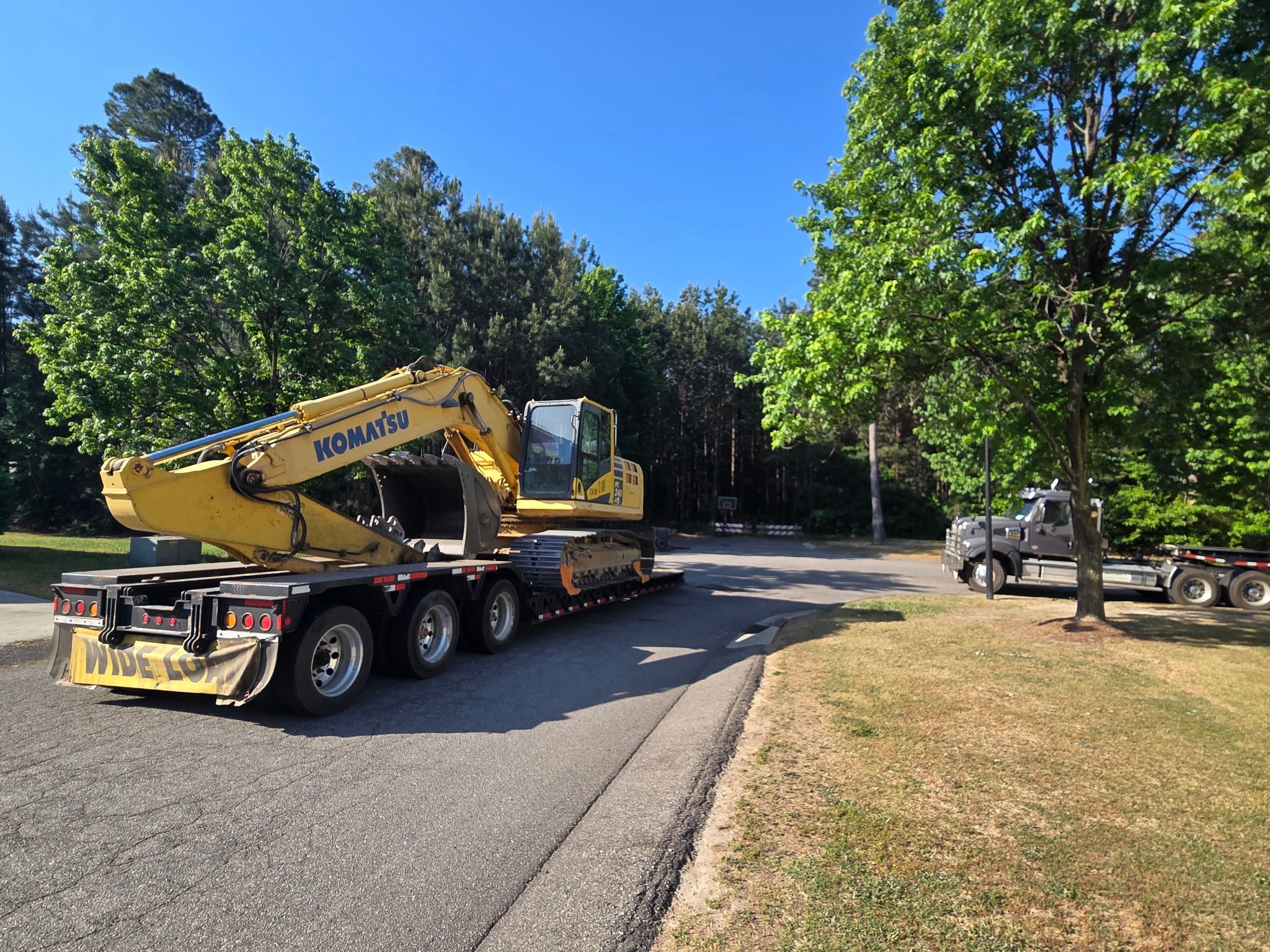
Many pieces of construction and logging equipment break one or more of those limits the moment they roll up the ramp of a low-boy. That's where the permit conversation begins.
NCDOT issues oversize/overweight permits through the Single Trip Oversize/Overweight Vehicle Permit system. Depending on the dimensions, the load may require:
A permit specifying an approved route
One or more pilot/escort vehicles (front, rear, or both)
A daylight-only restriction
A weekend / holiday movement restriction (statewide bans typically apply)
Banner flags, signage, and lighting
Specific signage, height-clearance verification, or NCDOT engineering review for super-loads
A hauler who treats permitting as an afterthought is a hauler who's going to hold up your schedule. A hauler who knows the permit office and routes well is a hauler whose first move is to check the route before they quote the job.
The eight questions that separate a real hauler from an opportunist
If you're evaluating a heavy-haul partner, for a regular schedule or just for the contact list, here's what's worth asking:
1. "What equipment do you operate in-house?" Tractors and trailers should be company-owned and professionally maintained. Lowboys, RGNs, step-decks, gooseneck trailers, the inventory should match the work. A company that has to broker out the actual move isn't a hauler, it's a dispatcher.
2. "Are your drivers Class A CDL with the right endorsements?" Class A CDL is table stakes. For tank loads, hazmat, or doubles, the appropriate endorsements should be in place. Ask whether drivers are W-2 employees or independent owner-operators. Either model can work, but you want clarity.
3. "What's your DOT number, and what's your safety record?" Pull the carrier's SAFER (Safety and Fitness Electronic Records) profile and look at the most recent BASIC scores. Out-of-service rates, crash history, inspection history. A few violations are normal across any large fleet; a pattern is a flag.
4. "How do you handle permits for oversize/overweight loads?" The right answer involves an in-house dispatcher who pulls NCDOT single-trip permits, plans the route, and identifies pilot car requirements before the load moves. Not a phone call to the customer asking them to figure it out.
5. "Are pilot cars/escorts included, or billed separately?" Should be specified up front. For loads requiring escorts, the contractor should have a working relationship with certified pilot car operators in the region.
6. "What's your insurance posture?" Standard heavy-haul coverage includes auto liability (typically $1M+), cargo insurance for the equipment being moved, and general liability. Ask for a Certificate of Insurance naming the project as an additional insured if required.
7. "What's your typical response time on a same-day or next-day move?" Heavy hauling lives or dies on dispatch. The reasonable answer for a regional hauler in central NC is "same-day if we're in the area, next-day if we need to repo a trailer." If the answer is "a week or two," that's a planned-move-only partner.
8. "Have you moved this specific class of equipment before?" Excavators, dozers, feller-bunchers, milling machines, crushers, cranes, and modular building sections each have their own loading, securement, and routing considerations. Experience matters.
The "pinch call" capability is the real differentiator
Most heavy-haul contractors will service a planned schedule fine. Where the differences show up is the day a contractor needs a piece moved within hours, not days.
A few signals that a hauler can actually handle pinch calls:
Dispatch picks up the phone before voicemail. This sounds obvious. It is not common.
They know what equipment is closest to your site at any given moment. Real-time fleet visibility, not "let me check and call you back tomorrow."
They've handled emergency repos. When a competing hauler's trailer breaks down, somebody has to pick up the load. The contractors who routinely take those calls are the ones who can take yours.
They run their own integrated operation. Companies that haul for their own logging or contracting work move equipment between job sites every day. That same fleet capacity is what makes them flexible when an outside contractor calls in a hurry.
The transcript from our team's last operations review captured this directly: "Heavy hall stuff is normally within a day or a few hours because everyone when they're calling to move a machine, they want it moved quickly. We have done some emergency jobs where the contractor that bid it couldn't get there in time and we were the second bid or something." That second-bid call gets made all the time in central NC. The companies on the other end of it are the ones worth knowing before you need them.
A note on raw timber, wood chips, and C&D debris
Heavy haul isn't only equipment. For NC contractors and developers, the same trailer fleet often moves:
Raw timber from harvest sites to forest product mills.
Wood chips and mulch from clearing sites to end users.
Construction and demolition (C&D) debris from sites to disposal facilities.
Aggregate, rock, and topsoil to the project location.
The advantage of a hauler who handles all of these is sequencing. On a large land-clearing job in central NC, the same fleet can move the equipment in, haul the timber out, transport the chips, and remove the C&D debris, without waiting on three separate trucking companies and three separate scheduling windows.
For more on how this plays out on the ground in this region, see our companion piece: Heavy Equipment Hauling in Central North Carolina: Keeping Contractors' Projects Moving.
How Timberline runs heavy haul
Timberline's Heavy Hauling division was built originally to support our own logging and contracting operations. As that fleet capacity grew, we opened it up to other NC contractors who needed a reliable hauler, particularly in central and eastern NC and the Raleigh area.
What that looks like in practice:
Modern, in-house fleet. Tractors and trailers we own, professionally maintained.
Class A CDL drivers. With the experience to load, secure, and route oversize equipment.
In-house dispatch. One number, one operations team, no broker layer.
Permitting handled. We pull NCDOT single-trip permits, plan the route, and coordinate pilot cars when required.
Same-day and next-day moves available. When we're in the area, we can usually move equipment same-day. Outside that window, next-day mobilization is normal.
C&D, timber, chips, and aggregate too. Same fleet, same dispatch.
The same fleet that moves our own equipment is what's available to other contractors who need a piece moved without waiting two weeks.
Need a heavy haul move in NC?
If you have a piece of equipment to move in central or eastern North Carolina, planned schedule or pinch call, give us a call at (919) 909-8630 or send a project note through the contact form.
For ongoing project work, we're happy to put a master service agreement in place so the call is faster the next time you need it.
Permitted Loads, Pilot Cars, and Pinch Calls: How NC Contractors Should Vet a Heavy-Haul Partner
There are two times a NC contractor calls a heavy-haul company.
The first is the planned move: a piece of equipment needs to swing from one job to the next, the dates are known, the load fits clean within standard permitting, and the crew has 48 hours of notice.
The second is the pinch call: it's 6:47 AM, the trackhoe that was supposed to be on site at 7:00 is stuck on a low-boy with a broken trailer axle two counties over, the GC is texting, the next subcontractor is waiting on grade, and the standard hauler can't move a piece for two weeks.
The heavy-haul partner you actually want is the one who handles both. The contractors who get burned are the ones who only think about hauling on the first kind of day.
This piece is for project managers, site superintendents, and equipment managers running active projects in central and eastern North Carolina. It walks through what to look for in a heavy-haul partner, what oversize permitting actually requires in NC, and how to evaluate a hauler before the day you really need them.
For context, Timberline runs an in-house heavy hauling division that moves construction, logging, and agricultural equipment, raw timber, wood chips, C&D debris, and aggregate across central and eastern NC. We move equipment for our own projects every day, and we move equipment for other contractors when they need a piece picked up in a hurry.
What "heavy haul" actually means in NC
For most NC contractors, "heavy haul" describes any load that exceeds standard legal limits on weight, width, length, or height; anything that requires a permit before it can roll on a public road. North Carolina's general legal limits without a permit are roughly:
Width: 8 feet 6 inches
Height: 13 feet 6 inches
Length: 53 feet for the trailer alone, 60 feet overall on Interstate, 40 feet trailer / 60 feet overall on non-Interstate (subject to specific equipment and statute)
Weight: 80,000 pounds gross vehicle weight on Interstate (axle and bridge formula limits also apply)
Many pieces of construction and logging equipment break one or more of those limits the moment they roll up the ramp of a low-boy. That's where the permit conversation begins.
NCDOT issues oversize/overweight permits through the Single Trip Oversize/Overweight Vehicle Permit system. Depending on the dimensions, the load may require:
A permit specifying an approved route
One or more pilot/escort vehicles (front, rear, or both)
A daylight-only restriction
A weekend / holiday movement restriction (statewide bans typically apply)
Banner flags, signage, and lighting
Specific signage, height-clearance verification, or NCDOT engineering review for super-loads
A hauler who treats permitting as an afterthought is a hauler who's going to hold up your schedule. A hauler who knows the permit office and routes well is a hauler whose first move is to check the route before they quote the job.
The eight questions that separate a real hauler from an opportunist
If you're evaluating a heavy-haul partner, for a regular schedule or just for the contact list, here's what's worth asking:
1. "What equipment do you operate in-house?" Tractors and trailers should be company-owned and professionally maintained. Lowboys, RGNs, step-decks, gooseneck trailers, the inventory should match the work. A company that has to broker out the actual move isn't a hauler, it's a dispatcher.
2. "Are your drivers Class A CDL with the right endorsements?" Class A CDL is table stakes. For tank loads, hazmat, or doubles, the appropriate endorsements should be in place. Ask whether drivers are W-2 employees or independent owner-operators. Either model can work, but you want clarity.
3. "What's your DOT number, and what's your safety record?" Pull the carrier's SAFER (Safety and Fitness Electronic Records) profile and look at the most recent BASIC scores. Out-of-service rates, crash history, inspection history. A few violations are normal across any large fleet; a pattern is a flag.
4. "How do you handle permits for oversize/overweight loads?" The right answer involves an in-house dispatcher who pulls NCDOT single-trip permits, plans the route, and identifies pilot car requirements before the load moves. Not a phone call to the customer asking them to figure it out.
5. "Are pilot cars/escorts included, or billed separately?" Should be specified up front. For loads requiring escorts, the contractor should have a working relationship with certified pilot car operators in the region.
6. "What's your insurance posture?" Standard heavy-haul coverage includes auto liability (typically $1M+), cargo insurance for the equipment being moved, and general liability. Ask for a Certificate of Insurance naming the project as an additional insured if required.
7. "What's your typical response time on a same-day or next-day move?" Heavy hauling lives or dies on dispatch. The reasonable answer for a regional hauler in central NC is "same-day if we're in the area, next-day if we need to repo a trailer." If the answer is "a week or two," that's a planned-move-only partner.
8. "Have you moved this specific class of equipment before?" Excavators, dozers, feller-bunchers, milling machines, crushers, cranes, and modular building sections each have their own loading, securement, and routing considerations. Experience matters.
The "pinch call" capability is the real differentiator
Most heavy-haul contractors will service a planned schedule fine. Where the differences show up is the day a contractor needs a piece moved within hours, not days.
A few signals that a hauler can actually handle pinch calls:
Dispatch picks up the phone before voicemail. This sounds obvious. It is not common.
They know what equipment is closest to your site at any given moment. Real-time fleet visibility, not "let me check and call you back tomorrow."
They've handled emergency repos. When a competing hauler's trailer breaks down, somebody has to pick up the load. The contractors who routinely take those calls are the ones who can take yours.
They run their own integrated operation. Companies that haul for their own logging or contracting work move equipment between job sites every day. That same fleet capacity is what makes them flexible when an outside contractor calls in a hurry.
The transcript from our team's last operations review captured this directly: "Heavy hall stuff is normally within a day or a few hours because everyone when they're calling to move a machine, they want it moved quickly. We have done some emergency jobs where the contractor that bid it couldn't get there in time and we were the second bid or something." That second-bid call gets made all the time in central NC. The companies on the other end of it are the ones worth knowing before you need them.
A note on raw timber, wood chips, and C&D debris
Heavy haul isn't only equipment. For NC contractors and developers, the same trailer fleet often moves:
Raw timber from harvest sites to forest product mills.
Wood chips and mulch from clearing sites to end users.
Construction and demolition (C&D) debris from sites to disposal facilities.
Aggregate, rock, and topsoil to the project location.
The advantage of a hauler who handles all of these is sequencing. On a large land-clearing job in central NC, the same fleet can move the equipment in, haul the timber out, transport the chips, and remove the C&D debris, without waiting on three separate trucking companies and three separate scheduling windows.
For more on how this plays out on the ground in this region, see our companion piece: Heavy Equipment Hauling in Central North Carolina: Keeping Contractors' Projects Moving.
How Timberline runs heavy haul
Timberline's Heavy Hauling division was built originally to support our own logging and contracting operations. As that fleet capacity grew, we opened it up to other NC contractors who needed a reliable hauler, particularly in central and eastern NC and the Raleigh area.
What that looks like in practice:
Modern, in-house fleet. Tractors and trailers we own, professionally maintained.
Class A CDL drivers. With the experience to load, secure, and route oversize equipment.
In-house dispatch. One number, one operations team, no broker layer.
Permitting handled. We pull NCDOT single-trip permits, plan the route, and coordinate pilot cars when required.
Same-day and next-day moves available. When we're in the area, we can usually move equipment same-day. Outside that window, next-day mobilization is normal.
C&D, timber, chips, and aggregate too. Same fleet, same dispatch.
The same fleet that moves our own equipment is what's available to other contractors who need a piece moved without waiting two weeks.
Need a heavy haul move in NC?
If you have a piece of equipment to move in central or eastern North Carolina, planned schedule or pinch call, give us a call at (919) 909-8630 or send a project note through the contact form.
For ongoing project work, we're happy to put a master service agreement in place so the call is faster the next time you need it.