2025-07-14
How to Build a Gravel Road Through a Rural Property in North Carolina
A practical seven-step guide to planning, permitting, and constructing a gravel access road on rural North Carolina property, from route flagging to final compaction and ongoing maintenance.

How to Build a Gravel Road Through a Rural Property in North Carolina
Building a gravel road through rural North Carolina land is a seven-step job: flag the route, secure driveway and erosion permits, clear and grub the corridor, cut and shape the subgrade with proper crown and ditches, lay geotextile fabric where soils are wet, place and compact a base course of ABC stone, then top with a wearing course. Done right on typical Piedmont or Coastal Plain soils, a 12 to 14 foot wide road with 2 to 4 foot shoulders will carry loaded log trucks, concrete mixers, and a family SUV for decades with only light annual maintenance. Skip a step and you will be regrading washouts every spring.
Here is the sequence that works, and why each step matters.
Step 1: Walk the Route and Flag the Centerline
Before a blade touches dirt, walk the property with a handheld GPS and ribbon. You are looking for the driest, straightest, gentlest path from the public road to your interior destination, whether that is a home site, a log deck, or a field.
Avoid crossing wet-weather branches if you can. Every stream crossing means a culvert, a permit, and a lifetime of maintenance. Aim for grades under 8 percent; above 10 percent, gravel migrates downhill every rain. Skirt the toes of steep slopes rather than cutting across them. In eastern NC, look hard at soil survey maps for hydric soils; a route that runs 300 feet longer around a wet flat is cheaper than one that runs straight through it.
Step 2: Pull the Permits
In North Carolina, three permits usually apply:
NCDOT driveway permit. Required for any new connection to a state-maintained road. NCDOT will specify sight distance, pipe size under the apron, and paved radius if applicable.
County erosion and sediment control plan. Any land-disturbing activity over one acre triggers a state or delegated-local program plan. A long access road easily crosses that threshold.
404/401 stream or wetland permit. If you cross a blue-line stream or jurisdictional wetland, the Army Corps and NCDEQ get involved. Most rural crossings qualify for a Nationwide Permit 14, but you must file.
Pull these first. Starting work without them is the fastest way to a stop-work order.
Step 3: Clear and Grub the Corridor
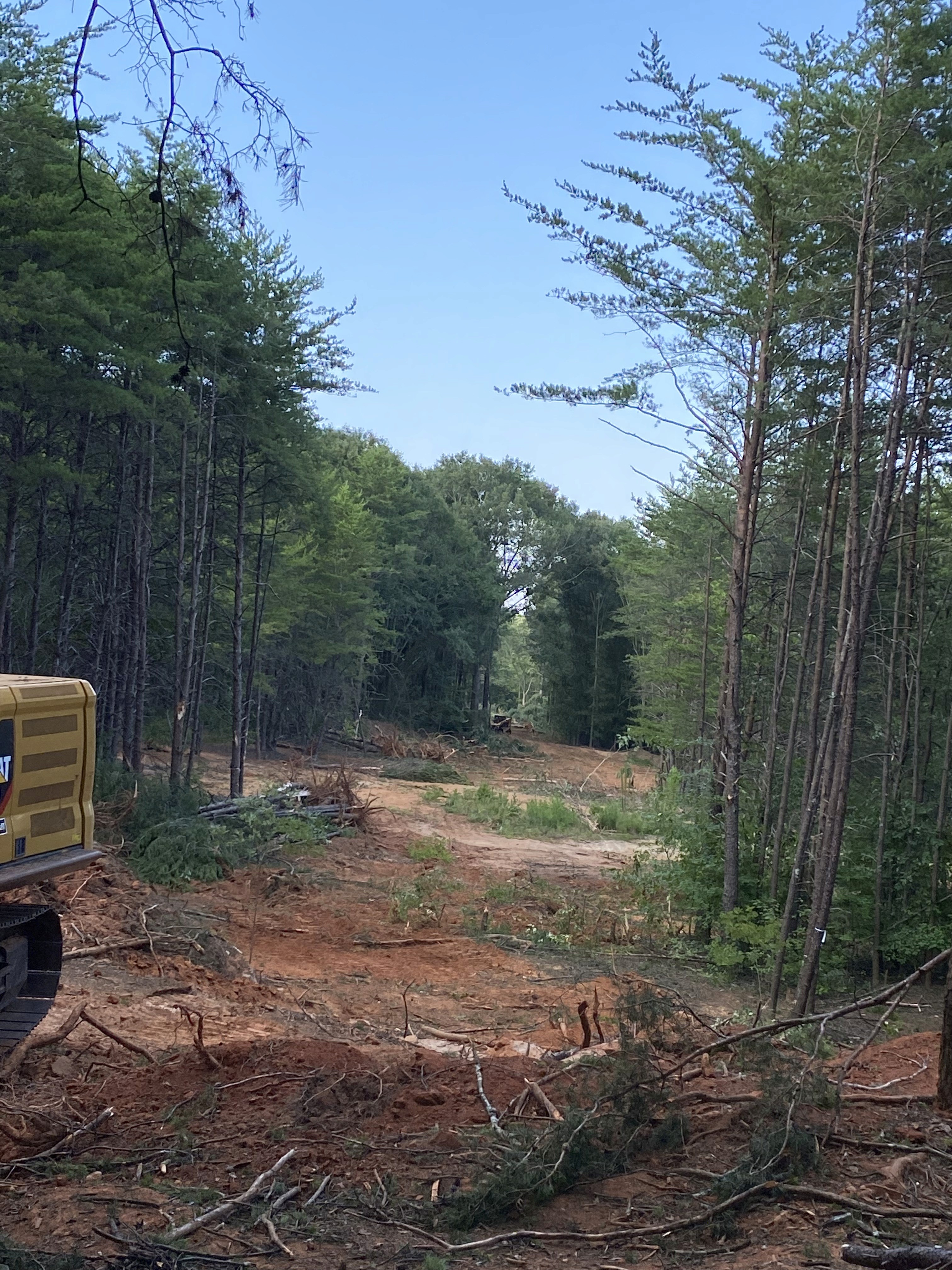
Clear a corridor about 6 feet wider than your finished road on each side. That gives you room for ditches, shoulders, and sunlight to dry the surface. Grubbing (removing stumps and root balls) is non-negotiable. Buried organics rot, settle, and create the soft spots that eat gravel roads alive.
For wooded routes, this is where an integrated crew earns its keep. Timberline's forestry and contracting divisions can merchandise the standing timber in the corridor (selling saw logs and pulpwood to offset road cost) and then bring in the same fleet to grub, grade, and haul stone. One mobilization instead of three.
Step 4: Cut the Subgrade with Crown and Ditches
Shape the native soil into the final road template before any stone touches it. Build a 2 to 4 percent crown from centerline to shoulder so water sheds sideways. Cut V-ditches or parabolic ditches on both sides, sloped to drain to a stable outlet, never straight into a stream. Compact the subgrade with a smooth drum roller; if it pumps or ruts under the roller, it will pump under a loaded truck.
Step 5: Handle the Water Crossings
Size culverts for a 25-year storm at minimum. For most small NC drainages, that is a 24 to 36 inch smooth-wall HDPE or CMP pipe, bedded on 6 inches of stone and covered by at least a foot of compacted cover before any traffic. Add flared end sections and rip-rap aprons. Cheap culverts are the number one cause of road failure in this state.
Step 6: Lay Fabric, Then Stone
On any soil that is soft, silty, or seasonally wet, roll out a woven geotextile (Mirafi 500X or equivalent) across the full subgrade width before stone. Fabric is inexpensive insurance; it keeps fines from pumping up into your base and doubles the life of the road.
Then place stone in two lifts:
Base course: 6 to 8 inches of #4 or #57 stone for structure, compacted in place.
Wearing course: 3 to 4 inches of NCDOT ABC (aggregate base course), which contains fines that bind and shed water.
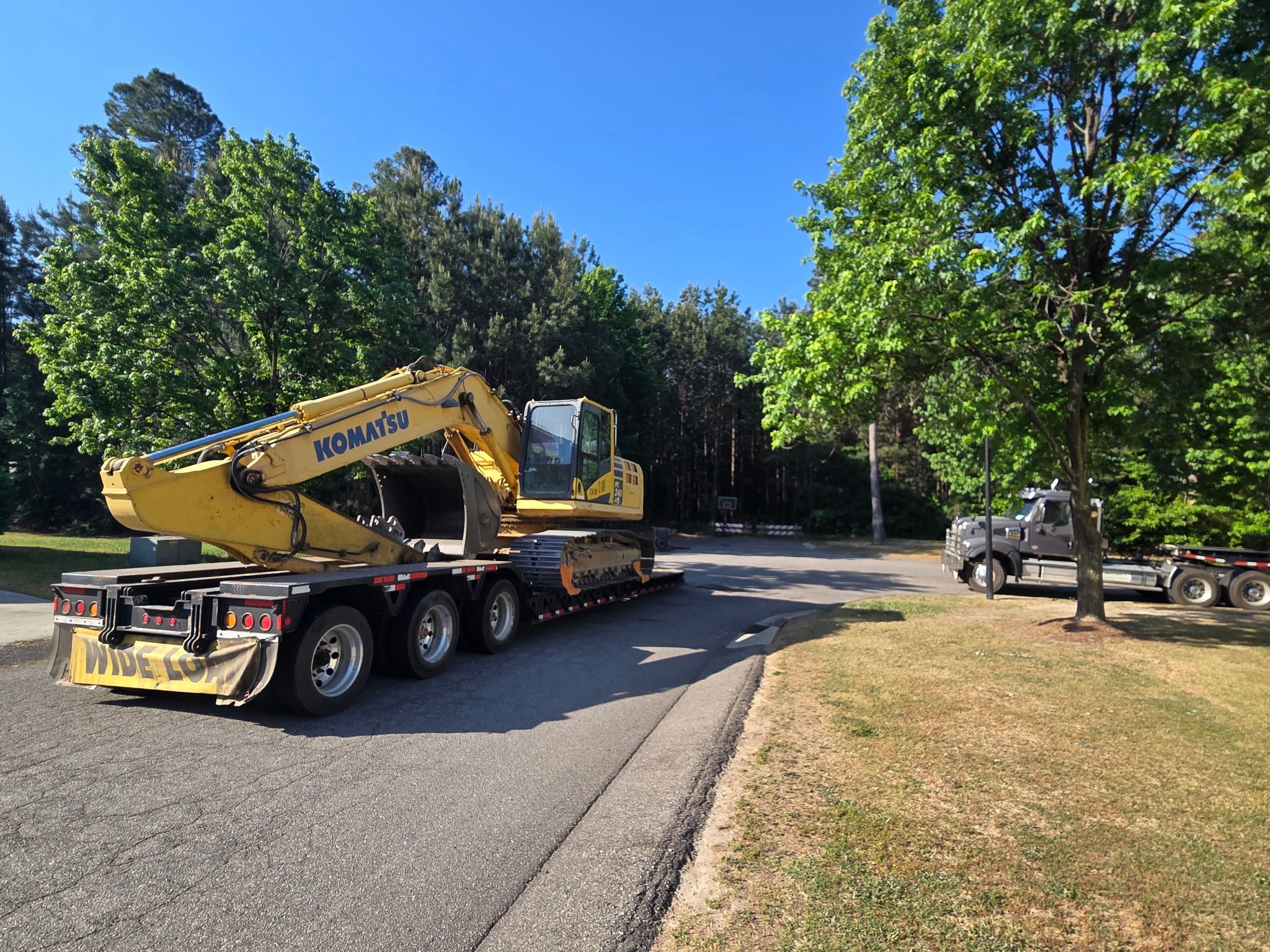
A 1,000-foot road at 14 feet wide with this section needs roughly 700 to 900 tons of stone. That is 25 to 35 tandem loads, which is where reliable heavy hauling matters. Late trucks mean idle graders.
Step 7: Compact, Shape, and Maintain
Roll each lift with a vibratory drum roller until it stops deflecting. Finish-grade with a motor grader to restore the crown. Then walk it after the first hard rain and touch up any low spots before they become potholes.
Maintenance is simple: grade twice a year, keep ditches open, and top-dress with a fresh inch of ABC every 3 to 5 years depending on traffic.
Where to Get Help
A rural access road touches timber, permits, grading, culverts, and hauling. Handling that with five different contractors is where budgets and schedules break. Timberline runs all of it in-house across NC, VA, SC, and GA. If you are planning an access road on a newly acquired tract, request a project estimate and we will walk the route with you.
How to Build a Gravel Road Through a Rural Property in North Carolina
Building a gravel road through rural North Carolina land is a seven-step job: flag the route, secure driveway and erosion permits, clear and grub the corridor, cut and shape the subgrade with proper crown and ditches, lay geotextile fabric where soils are wet, place and compact a base course of ABC stone, then top with a wearing course. Done right on typical Piedmont or Coastal Plain soils, a 12 to 14 foot wide road with 2 to 4 foot shoulders will carry loaded log trucks, concrete mixers, and a family SUV for decades with only light annual maintenance. Skip a step and you will be regrading washouts every spring.
Here is the sequence that works, and why each step matters.
Step 1: Walk the Route and Flag the Centerline
Before a blade touches dirt, walk the property with a handheld GPS and ribbon. You are looking for the driest, straightest, gentlest path from the public road to your interior destination, whether that is a home site, a log deck, or a field.
Avoid crossing wet-weather branches if you can. Every stream crossing means a culvert, a permit, and a lifetime of maintenance. Aim for grades under 8 percent; above 10 percent, gravel migrates downhill every rain. Skirt the toes of steep slopes rather than cutting across them. In eastern NC, look hard at soil survey maps for hydric soils; a route that runs 300 feet longer around a wet flat is cheaper than one that runs straight through it.
Step 2: Pull the Permits
In North Carolina, three permits usually apply:
NCDOT driveway permit. Required for any new connection to a state-maintained road. NCDOT will specify sight distance, pipe size under the apron, and paved radius if applicable.
County erosion and sediment control plan. Any land-disturbing activity over one acre triggers a state or delegated-local program plan. A long access road easily crosses that threshold.
404/401 stream or wetland permit. If you cross a blue-line stream or jurisdictional wetland, the Army Corps and NCDEQ get involved. Most rural crossings qualify for a Nationwide Permit 14, but you must file.
Pull these first. Starting work without them is the fastest way to a stop-work order.
Step 3: Clear and Grub the Corridor
Clear a corridor about 6 feet wider than your finished road on each side. That gives you room for ditches, shoulders, and sunlight to dry the surface. Grubbing (removing stumps and root balls) is non-negotiable. Buried organics rot, settle, and create the soft spots that eat gravel roads alive.
For wooded routes, this is where an integrated crew earns its keep. Timberline's forestry and contracting divisions can merchandise the standing timber in the corridor (selling saw logs and pulpwood to offset road cost) and then bring in the same fleet to grub, grade, and haul stone. One mobilization instead of three.
Step 4: Cut the Subgrade with Crown and Ditches
Shape the native soil into the final road template before any stone touches it. Build a 2 to 4 percent crown from centerline to shoulder so water sheds sideways. Cut V-ditches or parabolic ditches on both sides, sloped to drain to a stable outlet, never straight into a stream. Compact the subgrade with a smooth drum roller; if it pumps or ruts under the roller, it will pump under a loaded truck.
Step 5: Handle the Water Crossings
Size culverts for a 25-year storm at minimum. For most small NC drainages, that is a 24 to 36 inch smooth-wall HDPE or CMP pipe, bedded on 6 inches of stone and covered by at least a foot of compacted cover before any traffic. Add flared end sections and rip-rap aprons. Cheap culverts are the number one cause of road failure in this state.
Step 6: Lay Fabric, Then Stone
On any soil that is soft, silty, or seasonally wet, roll out a woven geotextile (Mirafi 500X or equivalent) across the full subgrade width before stone. Fabric is inexpensive insurance; it keeps fines from pumping up into your base and doubles the life of the road.
Then place stone in two lifts:
Base course: 6 to 8 inches of #4 or #57 stone for structure, compacted in place.
Wearing course: 3 to 4 inches of NCDOT ABC (aggregate base course), which contains fines that bind and shed water.
A 1,000-foot road at 14 feet wide with this section needs roughly 700 to 900 tons of stone. That is 25 to 35 tandem loads, which is where reliable heavy hauling matters. Late trucks mean idle graders.
Step 7: Compact, Shape, and Maintain
Roll each lift with a vibratory drum roller until it stops deflecting. Finish-grade with a motor grader to restore the crown. Then walk it after the first hard rain and touch up any low spots before they become potholes.
Maintenance is simple: grade twice a year, keep ditches open, and top-dress with a fresh inch of ABC every 3 to 5 years depending on traffic.
Where to Get Help
A rural access road touches timber, permits, grading, culverts, and hauling. Handling that with five different contractors is where budgets and schedules break. Timberline runs all of it in-house across NC, VA, SC, and GA. If you are planning an access road on a newly acquired tract, request a project estimate and we will walk the route with you.