2025-07-14T00:00:00.000Z
Land Clearing and Dirt Hauling: One Contractor or Two?
A practical guide for landowners weighing whether to hire one integrated clearing and hauling contractor or split the scope across two crews, with real cost and scheduling factors from Timberline Forestry.

Land clearing and dirt hauling on a large rural tract: one contractor or two?
Both models are common. The honest answer turns on scale. On a two-acre homesite, a local clearing outfit plus a separate dump truck service works fine and nobody loses money on it. On a large rural tract, call it 40 acres and up, the single-source model almost always wins. The two biggest cost drivers on a job that size are haul cycles and idle iron, and neither one gets solved when two companies are running separate schedules off separate calendars.
Here is the part most landowners do not know going in. The reason you keep hearing "you'll need two contractors" is not that two is better. It is that most clearing companies do not own trucks, and most trucking companies do not own mulchers, dozers or feller bunchers. The advice follows the equipment, not your project.
Where a split scope leaks money
You hire a clearing crew to knock down and process the vegetation, then a trucking or grading outfit to move dirt, spoil and stumps. On paper it is two clean invoices. In the field it is four problems.
Mobilization gets paid twice, sometimes three times. Moving a dozer, an excavator and a mulcher onto a rural tract with a soft entrance is a four-figure line item before anyone cuts a tree, and you are buying it again when the trucks arrive.
Sequencing slips. The trucker shows up the week the clearing crew is behind, or the clearing crew finishes clean and the trucks are booked out three weeks. You pay for that gap either way, in standby, in re-mobilization, or in a construction start date that moves.
Accountability blurs. When the entrance road ruts out or sediment leaves the site after a two-inch rain, each contractor points at the other. The notice of violation still comes to the landowner.
Timber value evaporates. This is the expensive one. A clearing-only contractor has no market for your merchantable pine or hardwood, so it gets mulched, piled or burned. Standing timber that could have offset a real share of the clearing bill leaves as smoke. If you have not priced what is out there, our breakdown of what drives standing timber value in North Carolina is a reasonable place to start before you sign anything.
What one contract changes
One superintendent, one fleet, machines moving between tasks as the site opens up. Mobilization is paid once and equipment already on the ground gets redeployed instead of demobilized. Dozers push and trucks load in the same week because the same dispatcher controls both, which also means cut and fill can be balanced on site rather than hauled off and then bought back later as trucked-in fill. There is one insurance certificate, one party responsible for erosion and sediment control, and one phone number when the county inspector pulls in.
The timber piece is the one worth doing arithmetic on. Take a 60-acre tract with 35 acres of merchantable loblolly on it. A partner who buys standing timber can credit that stumpage directly against the clearing and dirt work rather than treating the trees as debris to dispose of. On tracts with mature pine, that credit does not just trim the invoice. It changes which side of the ledger the job lands on.
The criteria that actually decide it
Volume of material leaving the site. A tri-axle dump carries roughly 14 to 16 cubic yards. A truck and pup or a belly dump carries considerably more. If you are moving thousands of yards, the gap between a contractor with four trucks and one with a real fleet is measured in weeks of schedule, not dollars per load.
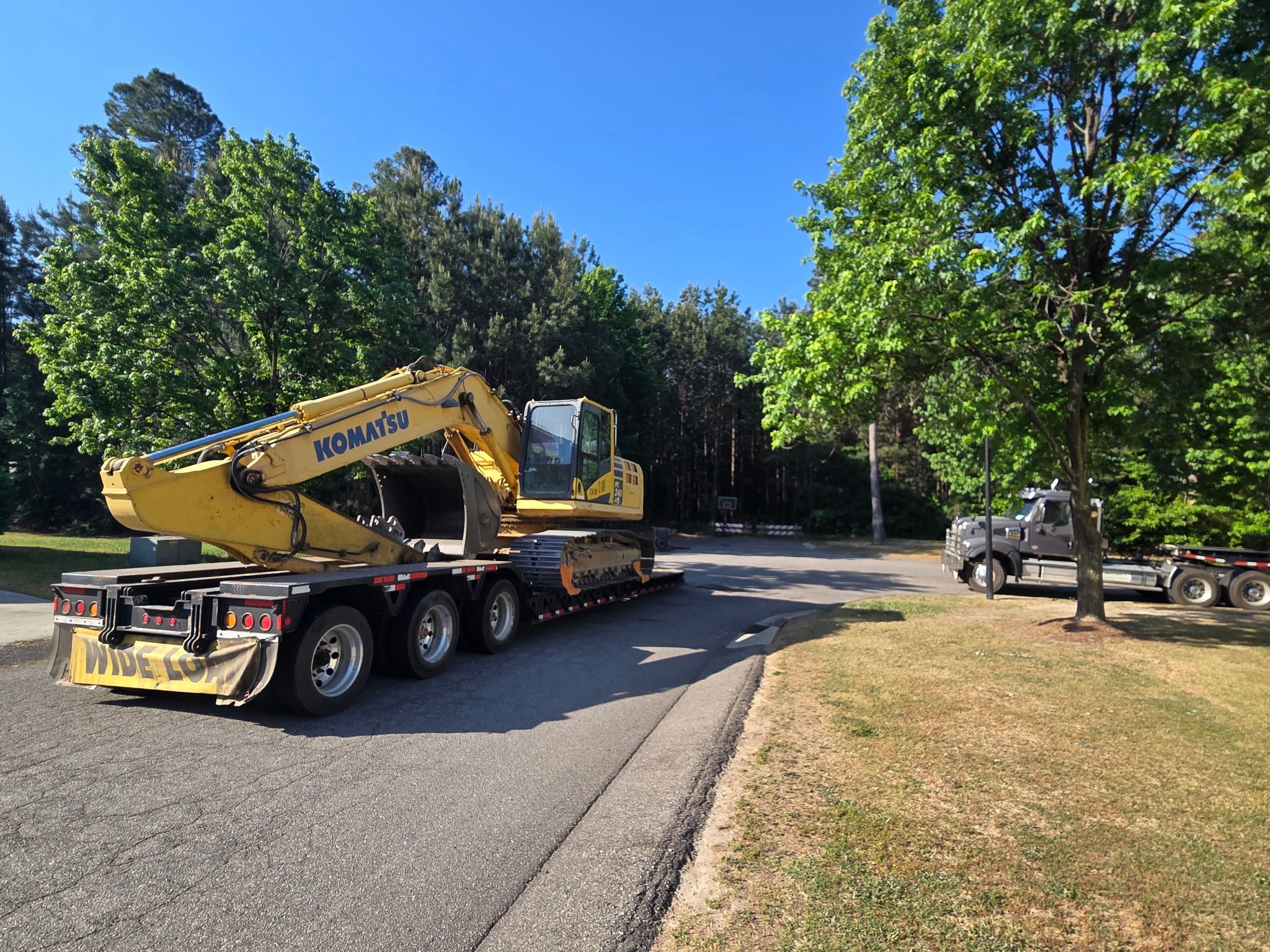
Permits and legal loads. Hauling on public roads means DOT numbers, weight compliance, and state permits for oversize equipment moves. If a scraper or a large excavator has to shift between phases, you want a lowboy operator who does that daily rather than monthly. We put the vetting questions in one place here: how to vet a heavy haul partner in North Carolina.
Land disturbance thresholds. In North Carolina, disturbing one acre or more triggers a sedimentation and erosion control plan with real inspection consequences behind it. Split contracts create seams in that plan. Whoever cleared the ground and whoever hauled from it both affect stabilization, but only one name is on the approved plan. Our field notes on erosion and sediment control for large NC sites cover what inspectors actually look for.
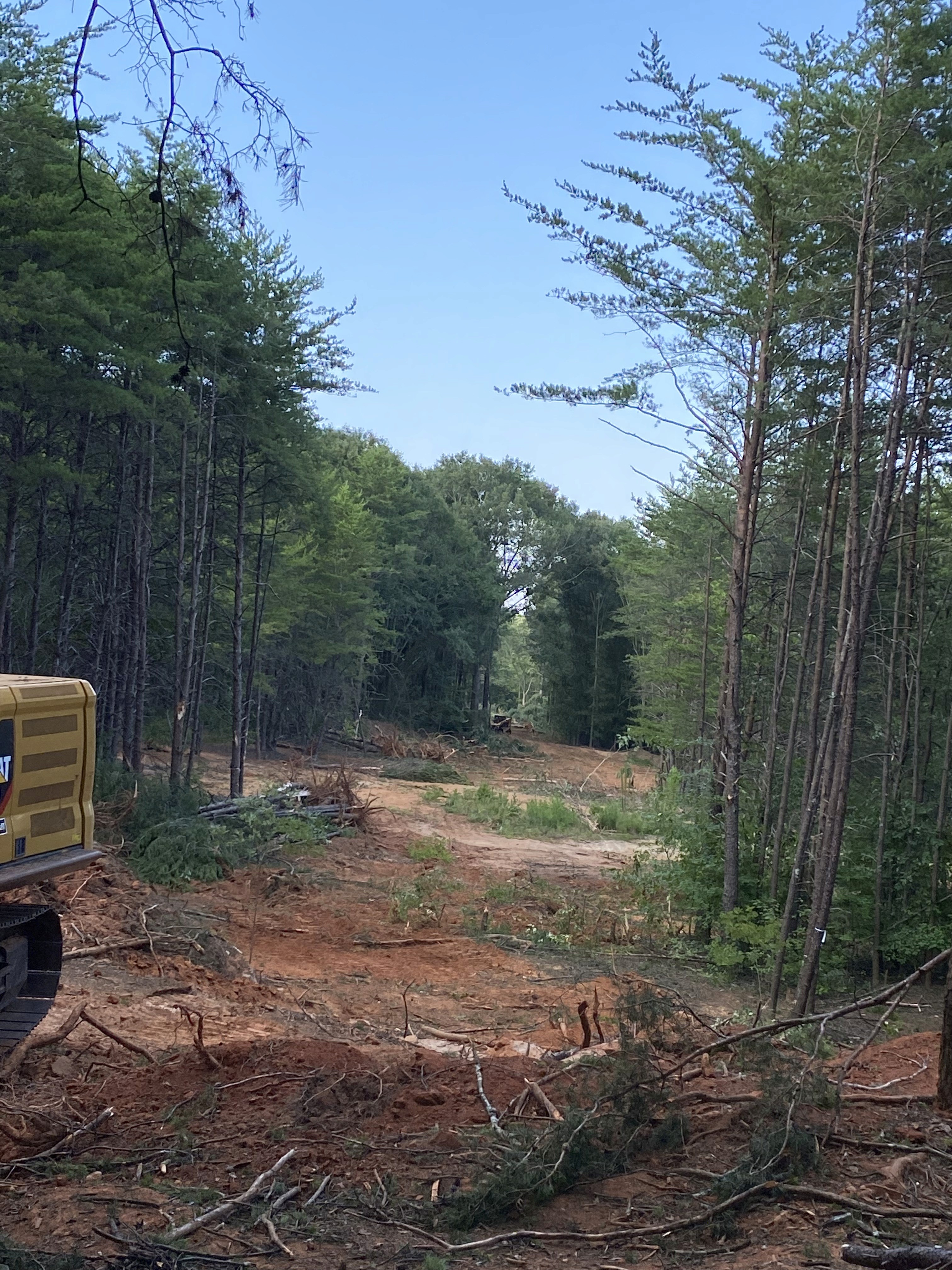
Access and haul road condition. On rural tracts the entrance is almost always the weak point. A single contractor builds and maintains that road as part of the job because his own trucks have to survive it. Two contractors argue about who tore it up.
So which one do you hire?
Hire two if the tract is small, the material is mostly vegetative, there is no merchantable timber, and you have the time and the patience to coordinate schedules yourself. Plenty of landowners do this and it works.
Hire one integrated contractor if the tract is large, if meaningful volumes of soil or stumps leave the site, if there is timber worth selling, if a development schedule is attached, or if you simply do not want to referee two crews for four months. For a phased development the sequencing question gets sharper still, and our framework for large-scale site clearing walks through the order of operations.
Timberline runs clearing, contracting, timber buying and heavy hauling as in-house divisions on one fleet, which is why we can bid the whole scope and credit timber value against the dirt work instead of billing you for burning it. Look at our contracting division and heavy hauling if you want the equipment list, or send us the tract boundary and we will tell you straight whether your job needs one contractor or two.
Land clearing and dirt hauling on a large rural tract: one contractor or two?
Both models are common. The honest answer turns on scale. On a two-acre homesite, a local clearing outfit plus a separate dump truck service works fine and nobody loses money on it. On a large rural tract, call it 40 acres and up, the single-source model almost always wins. The two biggest cost drivers on a job that size are haul cycles and idle iron, and neither one gets solved when two companies are running separate schedules off separate calendars.
Here is the part most landowners do not know going in. The reason you keep hearing "you'll need two contractors" is not that two is better. It is that most clearing companies do not own trucks, and most trucking companies do not own mulchers, dozers or feller bunchers. The advice follows the equipment, not your project.
Where a split scope leaks money
You hire a clearing crew to knock down and process the vegetation, then a trucking or grading outfit to move dirt, spoil and stumps. On paper it is two clean invoices. In the field it is four problems.
Mobilization gets paid twice, sometimes three times. Moving a dozer, an excavator and a mulcher onto a rural tract with a soft entrance is a four-figure line item before anyone cuts a tree, and you are buying it again when the trucks arrive.
Sequencing slips. The trucker shows up the week the clearing crew is behind, or the clearing crew finishes clean and the trucks are booked out three weeks. You pay for that gap either way, in standby, in re-mobilization, or in a construction start date that moves.
Accountability blurs. When the entrance road ruts out or sediment leaves the site after a two-inch rain, each contractor points at the other. The notice of violation still comes to the landowner.
Timber value evaporates. This is the expensive one. A clearing-only contractor has no market for your merchantable pine or hardwood, so it gets mulched, piled or burned. Standing timber that could have offset a real share of the clearing bill leaves as smoke. If you have not priced what is out there, our breakdown of what drives standing timber value in North Carolina is a reasonable place to start before you sign anything.
What one contract changes
One superintendent, one fleet, machines moving between tasks as the site opens up. Mobilization is paid once and equipment already on the ground gets redeployed instead of demobilized. Dozers push and trucks load in the same week because the same dispatcher controls both, which also means cut and fill can be balanced on site rather than hauled off and then bought back later as trucked-in fill. There is one insurance certificate, one party responsible for erosion and sediment control, and one phone number when the county inspector pulls in.
The timber piece is the one worth doing arithmetic on. Take a 60-acre tract with 35 acres of merchantable loblolly on it. A partner who buys standing timber can credit that stumpage directly against the clearing and dirt work rather than treating the trees as debris to dispose of. On tracts with mature pine, that credit does not just trim the invoice. It changes which side of the ledger the job lands on.
The criteria that actually decide it
Volume of material leaving the site. A tri-axle dump carries roughly 14 to 16 cubic yards. A truck and pup or a belly dump carries considerably more. If you are moving thousands of yards, the gap between a contractor with four trucks and one with a real fleet is measured in weeks of schedule, not dollars per load.
Permits and legal loads. Hauling on public roads means DOT numbers, weight compliance, and state permits for oversize equipment moves. If a scraper or a large excavator has to shift between phases, you want a lowboy operator who does that daily rather than monthly. We put the vetting questions in one place here: how to vet a heavy haul partner in North Carolina.
Land disturbance thresholds. In North Carolina, disturbing one acre or more triggers a sedimentation and erosion control plan with real inspection consequences behind it. Split contracts create seams in that plan. Whoever cleared the ground and whoever hauled from it both affect stabilization, but only one name is on the approved plan. Our field notes on erosion and sediment control for large NC sites cover what inspectors actually look for.
Access and haul road condition. On rural tracts the entrance is almost always the weak point. A single contractor builds and maintains that road as part of the job because his own trucks have to survive it. Two contractors argue about who tore it up.
So which one do you hire?
Hire two if the tract is small, the material is mostly vegetative, there is no merchantable timber, and you have the time and the patience to coordinate schedules yourself. Plenty of landowners do this and it works.
Hire one integrated contractor if the tract is large, if meaningful volumes of soil or stumps leave the site, if there is timber worth selling, if a development schedule is attached, or if you simply do not want to referee two crews for four months. For a phased development the sequencing question gets sharper still, and our framework for large-scale site clearing walks through the order of operations.
Timberline runs clearing, contracting, timber buying and heavy hauling as in-house divisions on one fleet, which is why we can bid the whole scope and credit timber value against the dirt work instead of billing you for burning it. Look at our contracting division and heavy hauling if you want the equipment list, or send us the tract boundary and we will tell you straight whether your job needs one contractor or two.