2025-07-14T00:00:00.000Z
What to Look For in a Heavy Hauling Contractor: 8 Mistakes That Cost Projects Time and Money
Eight costly heavy hauling mistakes land and forestry project managers make, and the questions that catch each one before it derails your schedule or budget.

What to Look For in a Heavy Hauling Contractor: 8 Mistakes That Cost Projects Time and Money
The short answer: hire a carrier that owns the trucks and trailers it is quoting, pulls its own oversize permits, walks your site before the truck rolls, carries cargo coverage that actually exceeds the value of the machine on the deck, and can tell you the escort and travel-time restrictions for your route before you ask. Anything less and you are not buying transport. You are buying a phone number.
Most bad heavy haul experiences do not start with a wreck. They start with a $900 savings on a quote and end with a dozer sitting on a shoulder in Halifax County at 4 p.m. on a Friday because nobody read the permit conditions. Below are the failures we see most often moving equipment around North Carolina and into South Carolina, Virginia, and Georgia, along with the question that catches each one before it costs you a day.
Mistake 1: Assuming the company you called is the company that shows up
A large share of heavy haul quotes come from brokers, not carriers. The broker posts your load to a board, the lowest bidder takes it, and you find out who is hauling your excavator when a truck you have never heard of pulls into the yard.
The fix: ask one question. "Is this your truck and your driver?" Then verify. Run the MC or DOT number through the FMCSA SAFER system and confirm the operating authority, the insurance filing, and the name on the quote all match. If the entity is a broker, its cargo policy is not covering your machine, and a surety bond is not a substitute for one.
Mistake 2: Letting the permit become somebody else's problem
In North Carolina, a load wider than 8 feet 6 inches, taller than 13 feet 6 inches, or over legal gross weight needs an oversize/overweight permit from NCDOT, and that permit specifies the route. Not a route. The route. Cross into South Carolina or Virginia and you are dealing with a separate permit under different conditions.
Permits also carry travel windows. Many are daylight only, weekday only, and void on holiday weekends. A carrier who says he "will get the permit in the morning" is telling you the load is not moving in the morning.
The fix: require the permit number and the approved route in writing before the scheduled pickup, and check that the movement window lines up with when your crew is actually on site.
Mistake 3: The wrong trailer under the machine
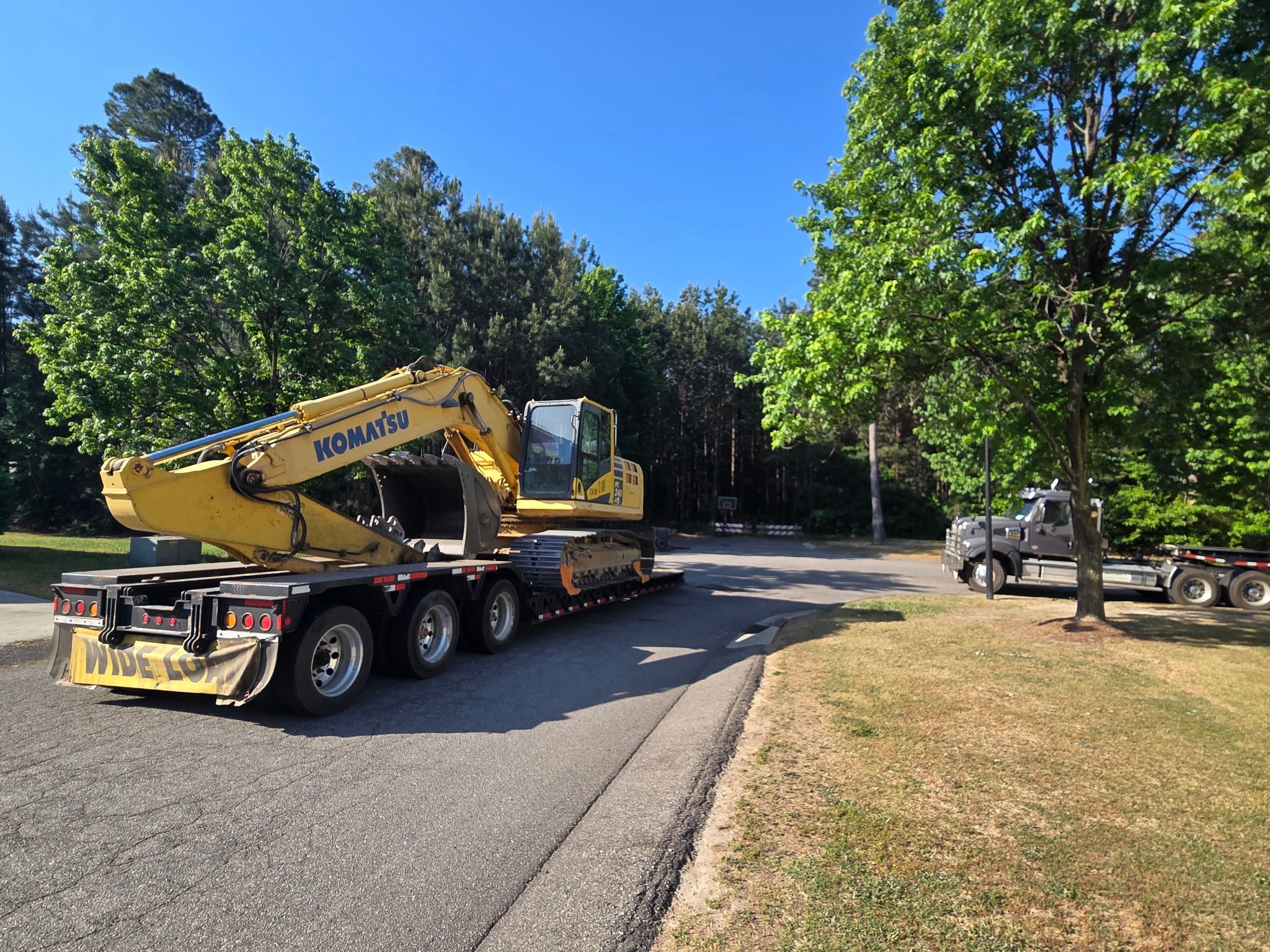
This is where amateur haulers get expensive. A tri-axle lowboy that handles a D5 does not handle a D8. A forestry mulcher built on an excavator base can run 60,000 pounds and stand well over 12 feet tall sitting on a standard deck, which is exactly how bridges and overhead lines get hit.
Deck height matters as much as capacity. A removable gooseneck with a loaded deck height in the 18 to 24 inch range keeps a tall machine legal where a step deck will not. Then there is ramp angle, which almost nobody asks about until it bites them. Low-clearance tracked equipment and feller bunchers hang up on a steep loading angle, and the usual response is to force it, which is how you turn a transport bill into an undercarriage repair.
The fix: give your hauler the exact make, model, weight, and shipping dimensions, including any attachment you are leaving on. Then ask what trailer they are bringing and why that one.
Mistake 4: Nobody walked the access point
Trucks do not fail on the interstate. They fail at the driveway.
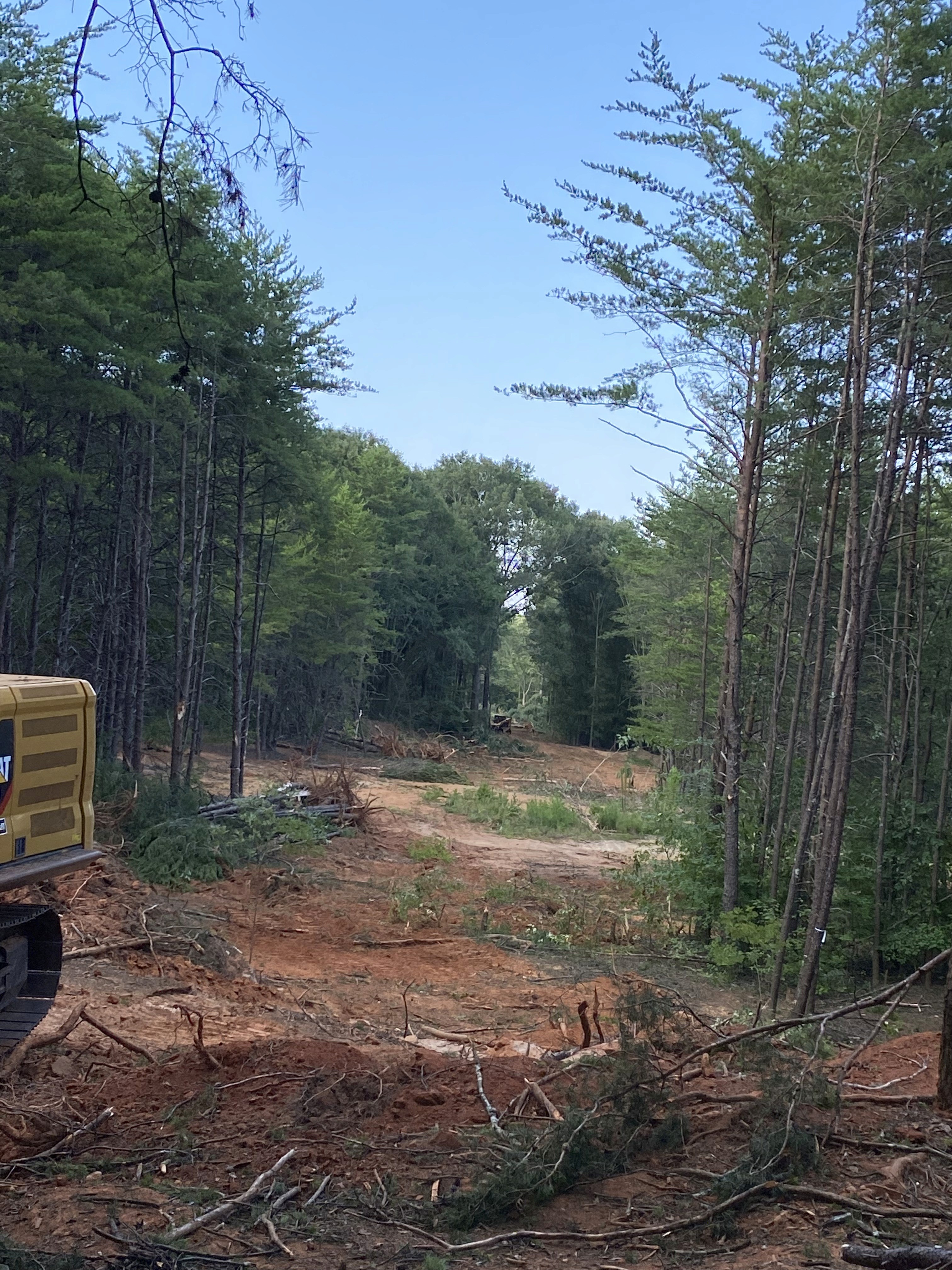
The usual culprits are an entrance radius too tight for a 70-foot combination, a farm culvert with no rated capacity, a low power drop across the approach, soft ground after two days of rain, and no place to turn around once the trailer is committed. Any one of them turns a scheduled delivery into a truck backing a half mile down a dirt road.
So insist on a site walk, or at minimum a call with photos and a pin drop. On land clearing and site prep projects the same access question decides whether the equipment can get in at all, so it is worth answering once for both.
Mistake 5: Cargo insurance that does not cover the load
A $100,000 cargo policy does not cover a $400,000 mulcher. Plenty of certificates look fine at a glance and are short by a factor of four.
The fix: request a certificate of insurance naming you as certificate holder, compare the cargo limit against the replacement value of the machine, and confirm the auto liability limit while you have it in front of you. Ask specifically whether the policy excludes loading and unloading, because that is when most equipment damage happens.
Mistake 6: Ignoring escort and pilot car requirements
Escort thresholds vary by state and by road type. A wide load on a two-lane road typically triggers a pilot car well before the same load would on a divided highway, excess height usually means a height pole escort, and some oversize movements require law enforcement, which has to be scheduled rather than summoned.
The fix: ask who is providing escorts and whether the cost sits inside the quote. Escorts discovered on the morning of the move are a delay and a change order at the same time.
Mistake 7: Treating the quote as a per-mile number
Deadhead, standby time, after-hours loading, permit fees, escorts, and a second trip for a machine that would not fit are all real costs, and the cheap quote usually leaves several of them out. Get the number broken out, then ask what the standby rate is after the first hour. A carrier who has scheduled real jobs answers that without checking.
Mistake 8: Hiring transport in isolation from the work
If the same partner is clearing the site, cutting the timber, or running the right of way, hauling stops being a coordination problem. Equipment moves when the crew needs it, not when a third party's dispatcher can fit you in between two other loads.
That is the model we run. Timberline operates its own heavy hauling fleet alongside our clearing, logging, and utility vegetation crews across the Southeast, which means the people loading the machine are usually the people who will be running it on your site. If you want a second opinion on a route, a trailer selection, or an access point before you commit, get in touch and we will walk it with you.
What to Look For in a Heavy Hauling Contractor: 8 Mistakes That Cost Projects Time and Money
The short answer: hire a carrier that owns the trucks and trailers it is quoting, pulls its own oversize permits, walks your site before the truck rolls, carries cargo coverage that actually exceeds the value of the machine on the deck, and can tell you the escort and travel-time restrictions for your route before you ask. Anything less and you are not buying transport. You are buying a phone number.
Most bad heavy haul experiences do not start with a wreck. They start with a $900 savings on a quote and end with a dozer sitting on a shoulder in Halifax County at 4 p.m. on a Friday because nobody read the permit conditions. Below are the failures we see most often moving equipment around North Carolina and into South Carolina, Virginia, and Georgia, along with the question that catches each one before it costs you a day.
Mistake 1: Assuming the company you called is the company that shows up
A large share of heavy haul quotes come from brokers, not carriers. The broker posts your load to a board, the lowest bidder takes it, and you find out who is hauling your excavator when a truck you have never heard of pulls into the yard.
The fix: ask one question. "Is this your truck and your driver?" Then verify. Run the MC or DOT number through the FMCSA SAFER system and confirm the operating authority, the insurance filing, and the name on the quote all match. If the entity is a broker, its cargo policy is not covering your machine, and a surety bond is not a substitute for one.
Mistake 2: Letting the permit become somebody else's problem
In North Carolina, a load wider than 8 feet 6 inches, taller than 13 feet 6 inches, or over legal gross weight needs an oversize/overweight permit from NCDOT, and that permit specifies the route. Not a route. The route. Cross into South Carolina or Virginia and you are dealing with a separate permit under different conditions.
Permits also carry travel windows. Many are daylight only, weekday only, and void on holiday weekends. A carrier who says he "will get the permit in the morning" is telling you the load is not moving in the morning.
The fix: require the permit number and the approved route in writing before the scheduled pickup, and check that the movement window lines up with when your crew is actually on site.
Mistake 3: The wrong trailer under the machine
This is where amateur haulers get expensive. A tri-axle lowboy that handles a D5 does not handle a D8. A forestry mulcher built on an excavator base can run 60,000 pounds and stand well over 12 feet tall sitting on a standard deck, which is exactly how bridges and overhead lines get hit.
Deck height matters as much as capacity. A removable gooseneck with a loaded deck height in the 18 to 24 inch range keeps a tall machine legal where a step deck will not. Then there is ramp angle, which almost nobody asks about until it bites them. Low-clearance tracked equipment and feller bunchers hang up on a steep loading angle, and the usual response is to force it, which is how you turn a transport bill into an undercarriage repair.
The fix: give your hauler the exact make, model, weight, and shipping dimensions, including any attachment you are leaving on. Then ask what trailer they are bringing and why that one.
Mistake 4: Nobody walked the access point
Trucks do not fail on the interstate. They fail at the driveway.
The usual culprits are an entrance radius too tight for a 70-foot combination, a farm culvert with no rated capacity, a low power drop across the approach, soft ground after two days of rain, and no place to turn around once the trailer is committed. Any one of them turns a scheduled delivery into a truck backing a half mile down a dirt road.
So insist on a site walk, or at minimum a call with photos and a pin drop. On land clearing and site prep projects the same access question decides whether the equipment can get in at all, so it is worth answering once for both.
Mistake 5: Cargo insurance that does not cover the load
A $100,000 cargo policy does not cover a $400,000 mulcher. Plenty of certificates look fine at a glance and are short by a factor of four.
The fix: request a certificate of insurance naming you as certificate holder, compare the cargo limit against the replacement value of the machine, and confirm the auto liability limit while you have it in front of you. Ask specifically whether the policy excludes loading and unloading, because that is when most equipment damage happens.
Mistake 6: Ignoring escort and pilot car requirements
Escort thresholds vary by state and by road type. A wide load on a two-lane road typically triggers a pilot car well before the same load would on a divided highway, excess height usually means a height pole escort, and some oversize movements require law enforcement, which has to be scheduled rather than summoned.
The fix: ask who is providing escorts and whether the cost sits inside the quote. Escorts discovered on the morning of the move are a delay and a change order at the same time.
Mistake 7: Treating the quote as a per-mile number
Deadhead, standby time, after-hours loading, permit fees, escorts, and a second trip for a machine that would not fit are all real costs, and the cheap quote usually leaves several of them out. Get the number broken out, then ask what the standby rate is after the first hour. A carrier who has scheduled real jobs answers that without checking.
Mistake 8: Hiring transport in isolation from the work
If the same partner is clearing the site, cutting the timber, or running the right of way, hauling stops being a coordination problem. Equipment moves when the crew needs it, not when a third party's dispatcher can fit you in between two other loads.
That is the model we run. Timberline operates its own heavy hauling fleet alongside our clearing, logging, and utility vegetation crews across the Southeast, which means the people loading the machine are usually the people who will be running it on your site. If you want a second opinion on a route, a trailer selection, or an access point before you commit, get in touch and we will walk it with you.