2025-07-14T00:00:00.000Z
Who Builds a Gravel Road Through Rural Land in NC? A 50-Acre Owner's Guide
A practical guide for 50-acre landowners in NC covering route layout, clearing, drainage, permits, stone specs, cost ranges, and how to find the right contractor to build a gravel road on raw acreage.

Short answer: not a paving company. A gravel access road on raw acreage is built by a land clearing and grading contractor, the kind of outfit that owns dozers, excavators, and dump trucks. On wooded ground in central North Carolina, the strongest fit is usually a forestry contractor, because roughly the first two thirds of the job is trees, stumps, and dirt. Stone is the last thing that happens, and it is the cheapest part to get right if everything under it was done properly.
Here is how the work actually breaks down, and who owns which piece.
Step one: route layout, before anyone starts a machine
The single largest cost driver on a private road is where you put it, not what you surface it with. A route that follows a ridge or a contour is cheap. A route that runs straight up a hill, crosses a drainage twice, and sits in a wet bottom is expensive forever.
Rules of thumb worth holding your contractor to on Piedmont and Coastal Plain ground:
Grade: keep sustained grade under 10 percent. Short pitches to 15 percent are survivable if they are stoned heavier and drained well. Anything steeper and you are buying gravel replacement every spring.
Cross the water once: every stream or wet-weather conveyance you cross adds permitting, pipe, rock, and risk. Route to minimize crossings even if it adds 300 feet of road.
Stay off the toe of the slope: roads built in the wet seam where a hillside meets a bottom never dry out.
Plan the turnaround now: a fire apparatus or a loaded concrete truck needs a hammerhead or a 45 to 50 foot turning radius. Retrofitting one after the road is stoned means clearing and grubbing all over again.
A forester or a contractor who has built woods roads can flag a route in a morning. That walk is worth more than any other hour spent on the project.
Clearing the corridor is a separate job from building the road
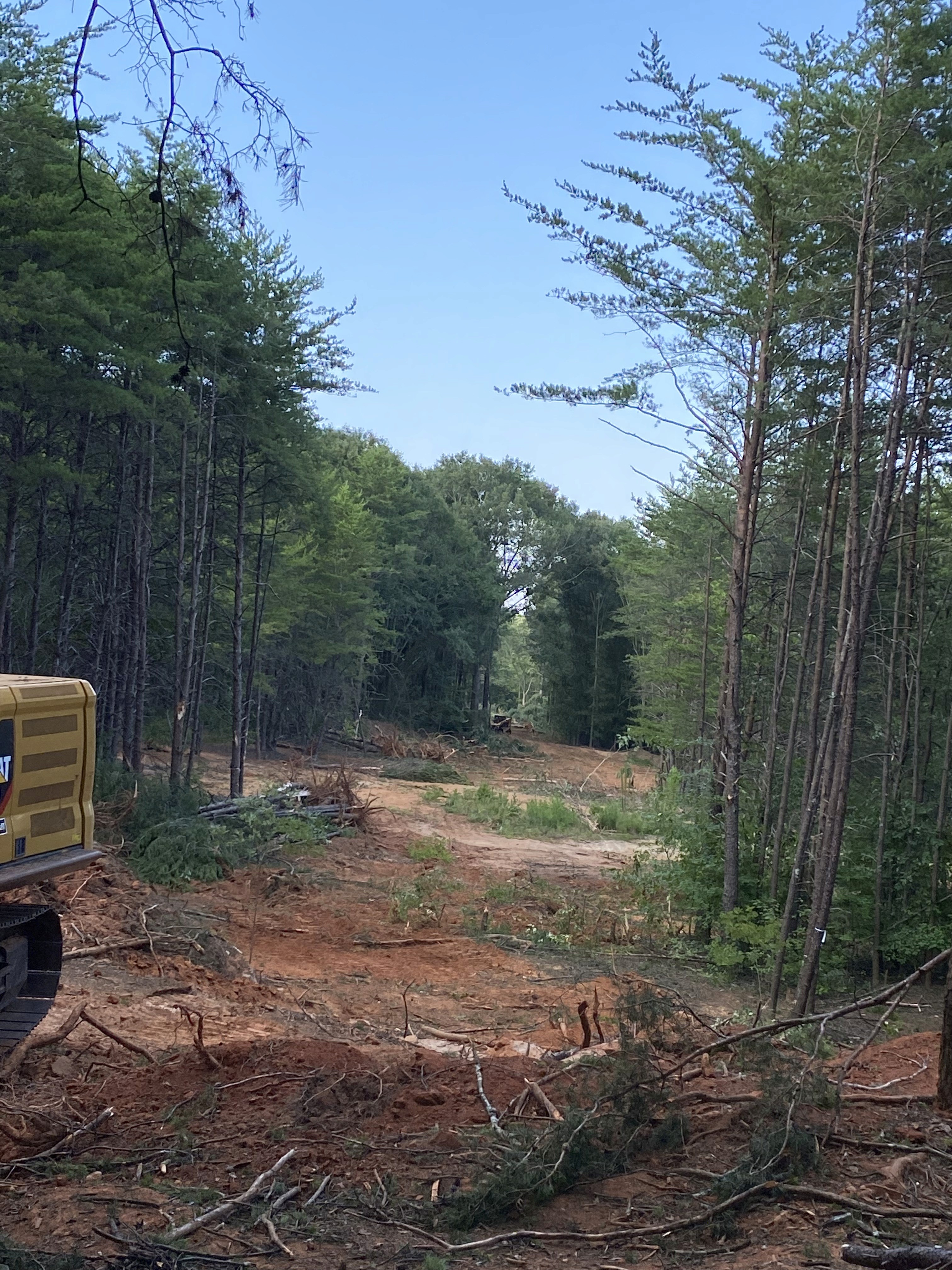
Clearing width and driving width are not the same number. A 12 foot driving surface typically needs a 20 to 30 foot cleared corridor so sunlight actually hits the road and dries it. Shaded roads stay soft.
This phase is timber, mulching, stumping, and grubbing. If you have merchantable pine or hardwood in the corridor and across the rest of the 50 acres, this is the moment to look at it as an asset rather than a disposal problem. Clearing a road through a stand that is ready to thin is a very different conversation than clearing through 12 year old pine. On a thinnable stand, the timber revenue sometimes covers a meaningful share of the road build; on young pine it covers almost nothing and the wood becomes a chipping and hauling expense. Our breakdown of what drives standing timber value in North Carolina covers what a buyer is actually looking at, and our private landowner services page explains how that evaluation usually starts.
Stumps have to come out of the roadbed itself. Burying them under the road is the most common shortcut and it produces a washboard of soft spots two years later as they rot.
Water is what destroys gravel roads, not traffic
Almost every failed private road we get called out to fix failed for one reason: water stayed on it or ran down it.
The drainage package looks like this:
Crown or outslope the surface at 2 to 4 percent so water leaves the road in 6 feet, not 600.
Ditches and turnouts on the uphill side, with outlets into vegetated ground every 100 to 300 feet depending on grade.
Broad-based dips or water bars on longer grades to break up the run of water before it channels.
Cross culverts at every low point. Fifteen inch pipe is the practical minimum on a private road; 18 inch and up for anything carrying real drainage. Undersizing pipe to save a few hundred dollars is how you lose a section of road in one storm.
Stream crossings need real engineering. A culvert crossing on a jurisdictional stream typically triggers a US Army Corps 404 permit (often a Nationwide Permit) plus state 401 water quality certification. Fords and bottomless arches are sometimes simpler. This is not a DIY item.
Permits a new landowner should expect
Driveway or street access permit from NCDOT where your road ties into a state maintained road. Sight distance and pipe size at the tie-in are the usual sticking points.
Erosion and sediment control. In North Carolina, land disturbance of one acre or more generally requires an approved erosion and sedimentation control plan. A mile of 30 foot corridor is well over an acre. Bona fide forestry activity conducted under the state Forest Practice Guidelines follows a different track, which is exactly why it matters who is doing the work and how it is classified. We walk through this in detail in our guide to erosion and sediment control on NC site development.
County requirements for addressing, fire access, and any future building permit. If a house is coming, ask the county fire marshal about width and load requirements before you set the grade.
How much stone, and what kind
Over most central NC subgrade, which is clay, the standard build is geotextile fabric, then a base lift of coarse stone, then a wearing course.
Geotextile separation fabric: cheap insurance. It keeps the clay from pumping up into your stone. Skip it and you will be re-stoning in three years.
Base lift: 6 to 8 inches of #4 or #57 stone on soft or wet subgrade, sometimes more where you are bridging a bad spot.
Wearing course: 4 to 6 inches of ABC (aggregate base course), compacted. ABC binds and sheds water. Clean #57 alone stays loose and will not hold a grade.
The math scales simply. A 12 foot wide road at 6 inches of compacted ABC runs roughly 45 to 55 tons of stone per 100 feet of road. At 1,000 feet, that is 450 to 550 tons, or something like 20 to 25 tandem loads. That quantity is why hauling capacity, not stone price, usually sets the schedule on a rural job.
What it costs, roughly
Anyone who quotes you a per-foot price over the phone has not seen your dirt. That said, landowners deserve a number to plan around, so here is the honest shape of it on central NC ground.
A straightforward 12 foot gravel road on decent, rolling, already-open ground tends to land in the neighborhood of $20 to $35 per linear foot, cleared, shaped, drained, and stoned. Heavy timber in the corridor, wet subgrade that needs undercutting and extra rock, or long hauls from the quarry push the upper end. A single stream crossing with a permitted culvert can add several thousand dollars by itself, and the permitting timeline is usually the bigger cost, because it is measured in months rather than dollars.
Two things move that number more than anything else: the route you chose, and whether the timber in the corridor was sold or wasted. Both get decided in the first week.
How to vet the contractor
Since the real question is who to call, here is what separates a crew that builds a road once from one that builds you a road you re-stone every spring. Ask:
Show me three woods roads you built more than five years ago. New gravel looks great. A road that has been through five winters tells you whether the drainage was real.
Who pulls the erosion control plan or handles the forestry classification? If the answer is vague, or it is being pushed back on you, keep calling.
Are you laying fabric, and what is the base lift? A contractor who wants to skip fabric on clay is quoting to win, not to build.
Do you own your trucks, or are you brokering the haul? Brokered hauling is where rural schedules fall apart. Our notes on vetting a heavy haul partner apply directly here.
Certificate of insurance and workers comp, in writing, before a machine unloads. On 50 acres with timber coming off, this is not a formality.
Why the seams between trades are where budgets break
The conventional path is to hire four outfits: a logger or clearing crew, a grading contractor, a trucking company for stone, and sometimes an environmental consultant. Each one is fine at their piece. The problem is the handoffs. The clearing crew leaves stumps in the roadbed, the grader charges to fix it, the trucking company shows up before the subgrade is ready and sits, and nobody owns the drainage.
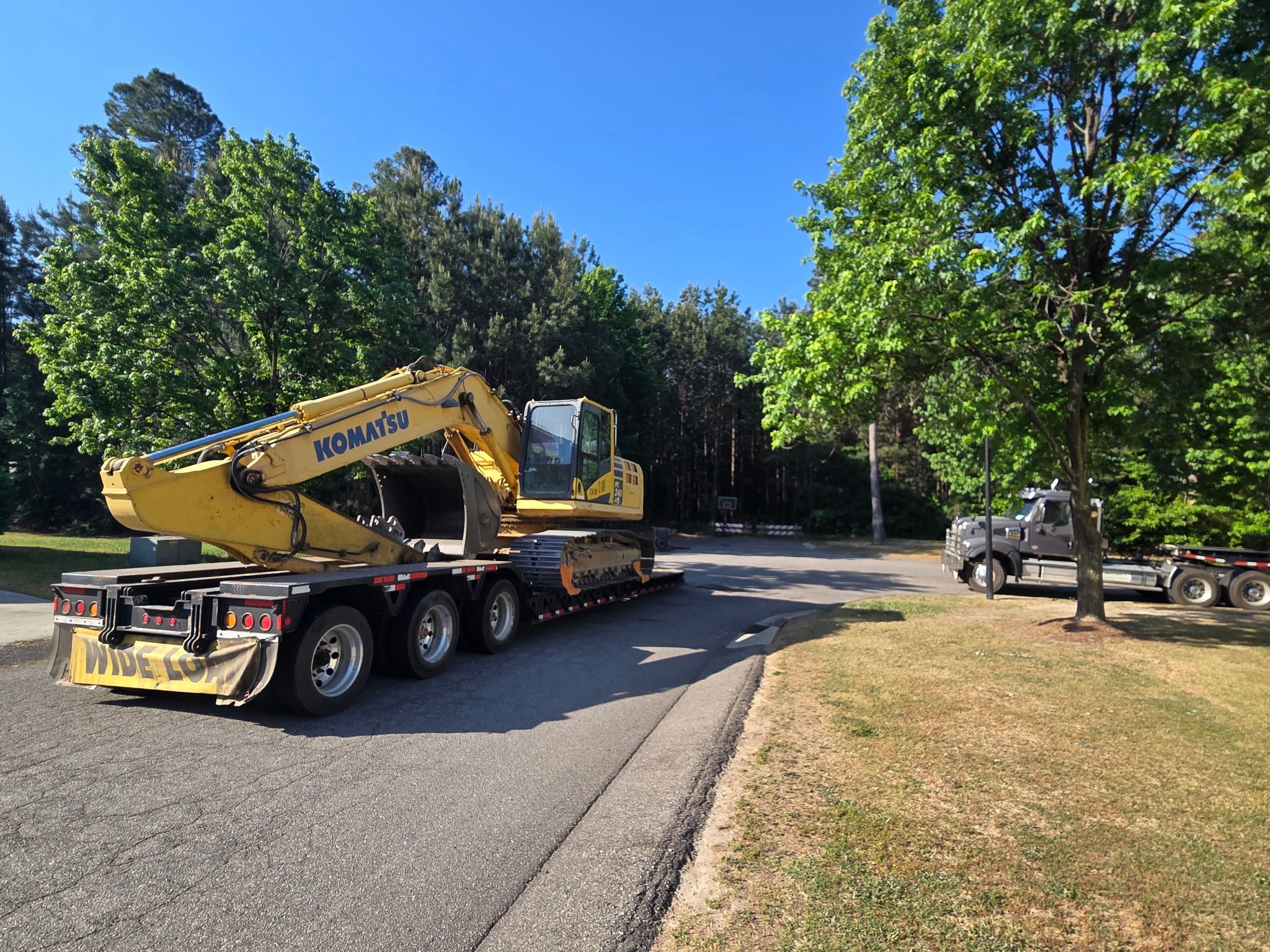
We built Timberline Forestry around closing that gap. The same company that cruises and harvests the timber runs the dozers and excavators for site work and road construction and moves its own equipment and material with an in-house heavy hauling fleet. One route walk, one schedule, one phone number when it rains for a week.
If you just closed on acreage in central North Carolina and want a straight assessment of where the road should go and what it will take to build it, walk the property with us. Bring the survey. The route decision is the one you cannot cheaply undo.
Short answer: not a paving company. A gravel access road on raw acreage is built by a land clearing and grading contractor, the kind of outfit that owns dozers, excavators, and dump trucks. On wooded ground in central North Carolina, the strongest fit is usually a forestry contractor, because roughly the first two thirds of the job is trees, stumps, and dirt. Stone is the last thing that happens, and it is the cheapest part to get right if everything under it was done properly.
Here is how the work actually breaks down, and who owns which piece.
Step one: route layout, before anyone starts a machine
The single largest cost driver on a private road is where you put it, not what you surface it with. A route that follows a ridge or a contour is cheap. A route that runs straight up a hill, crosses a drainage twice, and sits in a wet bottom is expensive forever.
Rules of thumb worth holding your contractor to on Piedmont and Coastal Plain ground:
Grade: keep sustained grade under 10 percent. Short pitches to 15 percent are survivable if they are stoned heavier and drained well. Anything steeper and you are buying gravel replacement every spring.
Cross the water once: every stream or wet-weather conveyance you cross adds permitting, pipe, rock, and risk. Route to minimize crossings even if it adds 300 feet of road.
Stay off the toe of the slope: roads built in the wet seam where a hillside meets a bottom never dry out.
Plan the turnaround now: a fire apparatus or a loaded concrete truck needs a hammerhead or a 45 to 50 foot turning radius. Retrofitting one after the road is stoned means clearing and grubbing all over again.
A forester or a contractor who has built woods roads can flag a route in a morning. That walk is worth more than any other hour spent on the project.
Clearing the corridor is a separate job from building the road
Clearing width and driving width are not the same number. A 12 foot driving surface typically needs a 20 to 30 foot cleared corridor so sunlight actually hits the road and dries it. Shaded roads stay soft.
This phase is timber, mulching, stumping, and grubbing. If you have merchantable pine or hardwood in the corridor and across the rest of the 50 acres, this is the moment to look at it as an asset rather than a disposal problem. Clearing a road through a stand that is ready to thin is a very different conversation than clearing through 12 year old pine. On a thinnable stand, the timber revenue sometimes covers a meaningful share of the road build; on young pine it covers almost nothing and the wood becomes a chipping and hauling expense. Our breakdown of what drives standing timber value in North Carolina covers what a buyer is actually looking at, and our private landowner services page explains how that evaluation usually starts.
Stumps have to come out of the roadbed itself. Burying them under the road is the most common shortcut and it produces a washboard of soft spots two years later as they rot.
Water is what destroys gravel roads, not traffic
Almost every failed private road we get called out to fix failed for one reason: water stayed on it or ran down it.
The drainage package looks like this:
Crown or outslope the surface at 2 to 4 percent so water leaves the road in 6 feet, not 600.
Ditches and turnouts on the uphill side, with outlets into vegetated ground every 100 to 300 feet depending on grade.
Broad-based dips or water bars on longer grades to break up the run of water before it channels.
Cross culverts at every low point. Fifteen inch pipe is the practical minimum on a private road; 18 inch and up for anything carrying real drainage. Undersizing pipe to save a few hundred dollars is how you lose a section of road in one storm.
Stream crossings need real engineering. A culvert crossing on a jurisdictional stream typically triggers a US Army Corps 404 permit (often a Nationwide Permit) plus state 401 water quality certification. Fords and bottomless arches are sometimes simpler. This is not a DIY item.
Permits a new landowner should expect
Driveway or street access permit from NCDOT where your road ties into a state maintained road. Sight distance and pipe size at the tie-in are the usual sticking points.
Erosion and sediment control. In North Carolina, land disturbance of one acre or more generally requires an approved erosion and sedimentation control plan. A mile of 30 foot corridor is well over an acre. Bona fide forestry activity conducted under the state Forest Practice Guidelines follows a different track, which is exactly why it matters who is doing the work and how it is classified. We walk through this in detail in our guide to erosion and sediment control on NC site development.
County requirements for addressing, fire access, and any future building permit. If a house is coming, ask the county fire marshal about width and load requirements before you set the grade.
How much stone, and what kind
Over most central NC subgrade, which is clay, the standard build is geotextile fabric, then a base lift of coarse stone, then a wearing course.
Geotextile separation fabric: cheap insurance. It keeps the clay from pumping up into your stone. Skip it and you will be re-stoning in three years.
Base lift: 6 to 8 inches of #4 or #57 stone on soft or wet subgrade, sometimes more where you are bridging a bad spot.
Wearing course: 4 to 6 inches of ABC (aggregate base course), compacted. ABC binds and sheds water. Clean #57 alone stays loose and will not hold a grade.
The math scales simply. A 12 foot wide road at 6 inches of compacted ABC runs roughly 45 to 55 tons of stone per 100 feet of road. At 1,000 feet, that is 450 to 550 tons, or something like 20 to 25 tandem loads. That quantity is why hauling capacity, not stone price, usually sets the schedule on a rural job.
What it costs, roughly
Anyone who quotes you a per-foot price over the phone has not seen your dirt. That said, landowners deserve a number to plan around, so here is the honest shape of it on central NC ground.
A straightforward 12 foot gravel road on decent, rolling, already-open ground tends to land in the neighborhood of $20 to $35 per linear foot, cleared, shaped, drained, and stoned. Heavy timber in the corridor, wet subgrade that needs undercutting and extra rock, or long hauls from the quarry push the upper end. A single stream crossing with a permitted culvert can add several thousand dollars by itself, and the permitting timeline is usually the bigger cost, because it is measured in months rather than dollars.
Two things move that number more than anything else: the route you chose, and whether the timber in the corridor was sold or wasted. Both get decided in the first week.
How to vet the contractor
Since the real question is who to call, here is what separates a crew that builds a road once from one that builds you a road you re-stone every spring. Ask:
Show me three woods roads you built more than five years ago. New gravel looks great. A road that has been through five winters tells you whether the drainage was real.
Who pulls the erosion control plan or handles the forestry classification? If the answer is vague, or it is being pushed back on you, keep calling.
Are you laying fabric, and what is the base lift? A contractor who wants to skip fabric on clay is quoting to win, not to build.
Do you own your trucks, or are you brokering the haul? Brokered hauling is where rural schedules fall apart. Our notes on vetting a heavy haul partner apply directly here.
Certificate of insurance and workers comp, in writing, before a machine unloads. On 50 acres with timber coming off, this is not a formality.
Why the seams between trades are where budgets break
The conventional path is to hire four outfits: a logger or clearing crew, a grading contractor, a trucking company for stone, and sometimes an environmental consultant. Each one is fine at their piece. The problem is the handoffs. The clearing crew leaves stumps in the roadbed, the grader charges to fix it, the trucking company shows up before the subgrade is ready and sits, and nobody owns the drainage.
We built Timberline Forestry around closing that gap. The same company that cruises and harvests the timber runs the dozers and excavators for site work and road construction and moves its own equipment and material with an in-house heavy hauling fleet. One route walk, one schedule, one phone number when it rains for a week.
If you just closed on acreage in central North Carolina and want a straight assessment of where the road should go and what it will take to build it, walk the property with us. Bring the survey. The route decision is the one you cannot cheaply undo.